Want to boost your conversion rates? It’s crucial to pinpoint the right areas in your customer journey. In this post we’ll explore the Goldfish archetype for B2B companies – how it works and why it’s key to shaping marketing strategies and driving revenue.
Strategy starts here
A winning sales strategy begins with creating a customer journey that converts. However, it’s essential to drift from thinking that this tool looks the same for all companies. A successful go to-market strategy requires a personalized approach tailored to each industry, business model and target market. While industries with low purchase stakes, such as the consumer market, typically show a simple—though not easy—customer path, B2B transactions involve higher customer engagement. This complexity sets the Goldfish archetype as an essential tool for understanding conversion rates across a more intricate and strategic customer path.
Frameworks we should care about
From AIDA to the 4A’s Traditionally, the customer funnel has been represented by the AIDA framework: Attention, Interest, Desire, and Action. This framework evolved into the 4A’s model, introduced by Derek Rucker of the Kellogg School of Management. His modern approach to the customer path simplifies the stages of Interest and Desire into one called Attitude, and adds a stage called Act Again to emphasize post-purchase behavior.
The 4A’s are: Awareness, Attitude, Act, Act Again. In practical terms, a customer becomes Aware of a brand, develops an Attitude of like or dislike towards it, decides to Act on a purchase and then decides whether to Act again if the purchase is worth repeating (Kotler, 2017).
Although the customer path is an ever-changing framework, the digital economy—an era characterized by interconnectivity, market inclusivity, globalization and horizontal relationships between brands and customers—demands a continuous revision of the customer path to address contemporary challenges of the digital era.
The New 5A’s
Philip Kotler proposed the 5A’s customer path in his book Marketing 4.0, which splits the Attitude stage into Appeal and Ask, recognizing that brand appeal is commonly influenced by a community. He also shines a light on the ‘new normal’ dynamics of interacting and connecting with a brand through traditional or digital touchpoints in the Ask phase.
The new 5A’s are as follows: Awareness, Appeal, Ask, Action and Advocacy for the brand, a component that has become essential for enhancing repeat business and customer loyalty.
What changes for B2B?
While the typical customer journey is shaped as a funnel, associating the Awareness phase with the top part of the funnel and the Advocacy phase with the bottom part, Kotler (2017) challenges this funnel shape with four archetypes. He recognizes that real-life customer paths are highly complex, influenced by a range of physical and digital channels, plus involve a diverse combination of touchpoints for each prospect.
In Marketing 4.0, Kotler introduces the Goldfish archetype, particularly relevant in B2B deals. While the 5A’s remain the same, the traditional funnel shape is altered due to high customer curiosity because B2B buyers often engage in extensive research, consult third-party resources, request multiple interactions with sellers and carefully analyze features, pricing and value before making a purchase decision. Consequently, the Ask phase becomes crucial in the decision-making process.
The Goldfish archetype in action
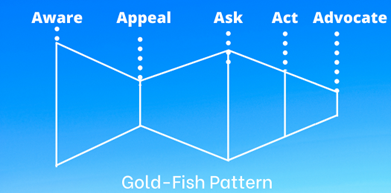
Imagine that out of every 100 web visitors, 10 are attracted to your product or service. This 10% conversion rate (CR) narrows the number of prospects moving from the Awareness stage to the Appeal stage, creating a steep funnel. In a typical funnel model, each stage becomes narrower due to a decreasing number of customers progressing through each phase.
However, in the Goldfish archetype, the Ask phase alters this shape. Suppose 50% of the 10 visitors (or 5 out of the 10) proceed to inquire, contact, or research more about your offering. This significant increase in engagement transforms the funnel into a Goldfish shape, contrasting with what usually happens in consumer-packaged goods (CPG) markets, where consumers spend less time researching due to lower stakes (e.g. products priced below $50) and minimal risk. In other words, people generally won’t spend weeks researching toothbrush brands—since the stakes are low, if they don’t like the product, they’ll simply choose another.
The funnel then narrows again into a typical cone-like shape. For instance, if 40% of those who inquired (or 2 out of the 5) decide to purchase by Acting, and only 50% of those purchasers (or 1 out of the 2) become an Advocate for the company, the Goldfish archetype illustrates the higher stakes involved in B2B contexts. In this scenario, corporate purchases often involve higher ticket prices and risks, such as the product or service not meeting expectations, and this complexity leads to a higher level of research which extends the decision-making process and results in longer sales cycles.
Achieving market results
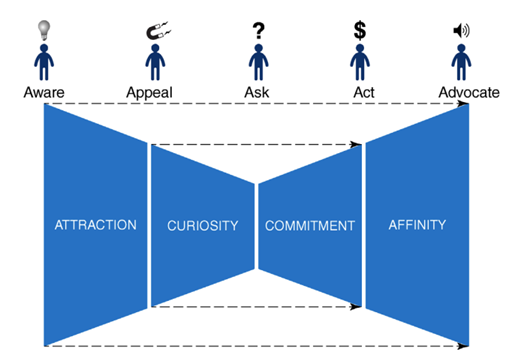
After understanding the customer journey dynamics for a B2B company, it’s useful to explore how it can be enhanced to increase productivity. The Goldfish archetype benefits when it evolves to resemble a Bow Tie shape, which is an archetype that drives strategic conversions.
The Bow Tie archetype
3 ways to work towards a Bow Tie shape
- Think long-term to increase affinity: closing a sale shouldn’t be the end goal for any business, especially in B2B. Given the high customer acquisition cost (CAC) for B2B deals, the most profitable sales often come from repeat business. Therefore, the post-purchase experience and stewardship become fundamental for building long-term relationships with clients. View sales as an opportunity for ongoing engagement rather than a one-time transaction to increase affinity, and ultimately Advocacy.
- Manage touchpoints to increase commitment: have you ever been set on buying an item, only to lose interest when it’s not available nearby? Customer commitment diminishes if their buying experience is not smooth throughout their journey. Customers need to quickly contact you, find product availability and navigate across channels without inconsistencies. Managing every touchpoint is essential to ensure a seamless path and avoid customer drop-off.
- Use content marketing to increase curiosity: Leveraging the power of content marketing helps consumers discover your brand and become interested very quickly. Many companies, such as Salesforce, IBM and Hubspot, provide free resources like blog posts that are engaging for their market category to generate curiosity among their target audience. You can do this through a strong online presence, a topic explored in my previous post.
Don’t forget the basics
Last but not least, consider these fundamental guidelines to leverage the particularities of a B2B customer journey:
- Highlight the benefits of your product/service, not just the product features.
- Clearly communicate your differentiation.
- Act as a guide rather than a salesperson. Always help your customers understand how your product stands out in the market for a specific target audience.
- Design your website for an audience seeking answers and use strategic call-to-actions (CTAs) effectively.
- Target decision-makers and address their business priorities and pains.
- Prioritize customer intimacy as your #1 objective.